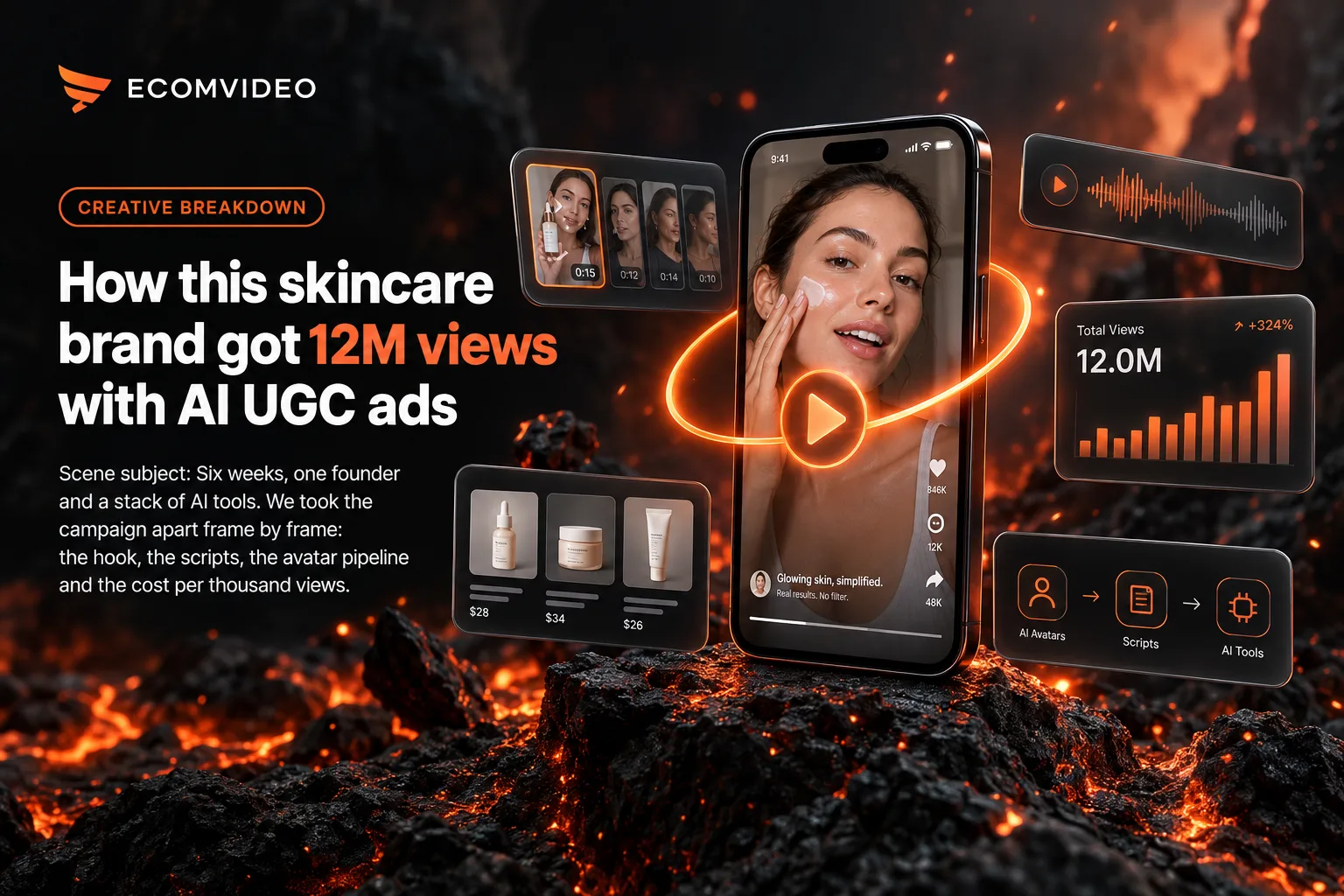
Halden Skin had a problem most small DTC brands will recognise. Its barrier serum sold well to people who tried it, but creator fees had climbed to the point where a single UGC video cost more than the brand made from it. In June, founder Mara Ekwueme stopped booking creators and started building the ads herself, with AI.
Six weeks later the campaign had 12.4M views across TikTok and Reels, a 3.1× return on ad spend and a cost per thousand views of $1.80. That is less than a fifth of what her creator-led ads cost in the spring.
The hook: product first, face second
Every winning variant opened on the product, not a person. The first frame is a macro shot of the serum hitting skin, generated from a single studio packshot. A face only appears at 1.4 seconds, after the scroll has already stopped.
We stopped trying to make AI look like a creator. We made it look like the product, and let the voice carry the trust.
That ordering matches what we saw in our own study of 2,184 ecommerce video ads: product-first openings held viewers past three seconds 38% more often than face-first ones in beauty.
The script system
Ekwueme wrote eight base scripts, each built on one customer objection pulled from reviews: “too sticky”, “does nothing”, “broke me out”. A language model produced twelve variations of each, keeping the objection and the proof point fixed while changing the opening line and the pacing.
The tool stack
Nothing here is exotic. Product footage came from Runway, avatars and voice from an off-the-shelf UGC tool, and captions and cuts from a mobile editor. The real work was the review step: every video was watched in full before going live, and roughly one in four was thrown away.
The results
Of 96 variants launched, nine produced 71% of the views. The winners had no visual style in common. What they shared was the objection: “broke me out” beat every other angle by a wide margin, so the next round of scripts was built entirely around it.


